
Sohee Goo shares a studio with Hongil Yoon. On her desk is a tray of egg-shaped objects, few of them eggs in the ordinary sense. Some are black and matte like river stones; others are clear or frosted, like the acrylic and silicone she has used elsewhere in her work. One is pink, one silver, one chalk white with a small mark at its base. Every one holds the same shape. No two look quite alike.
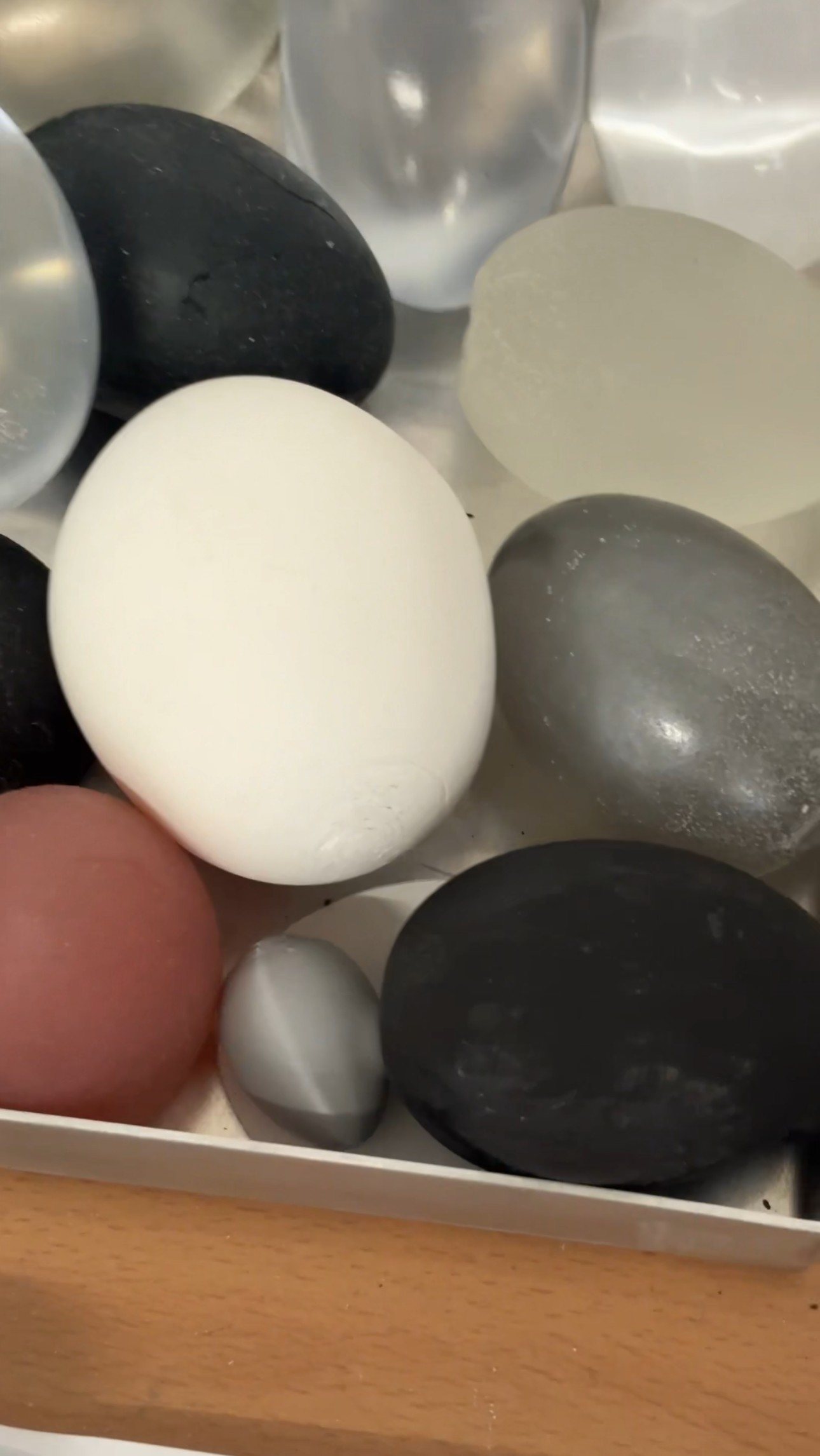
The tray is a key to the rest of the room. Goo, who trained in photography at the Royal College of Art, holds one thing fixed so that everything else can move. The egg stays; the surface, the scale, the focus and the medium change. Once the shape is constant, what we notice is difference: matte against gloss, opaque against clear, object against image.
On the wall the shape returns as a photograph, and here what changes is focus. A strip of prints, taped edge to edge, shows eggs photographed so far out of focus that they become soft masses of black and white. As the eye moves along it the masses merge, separate and merge again; in one print two dark forms nearly make a figure of eight, in the next a pale one swells until it fills the frame. We know they are eggs only because the tray is in the room. Without it they would be light and shadow.
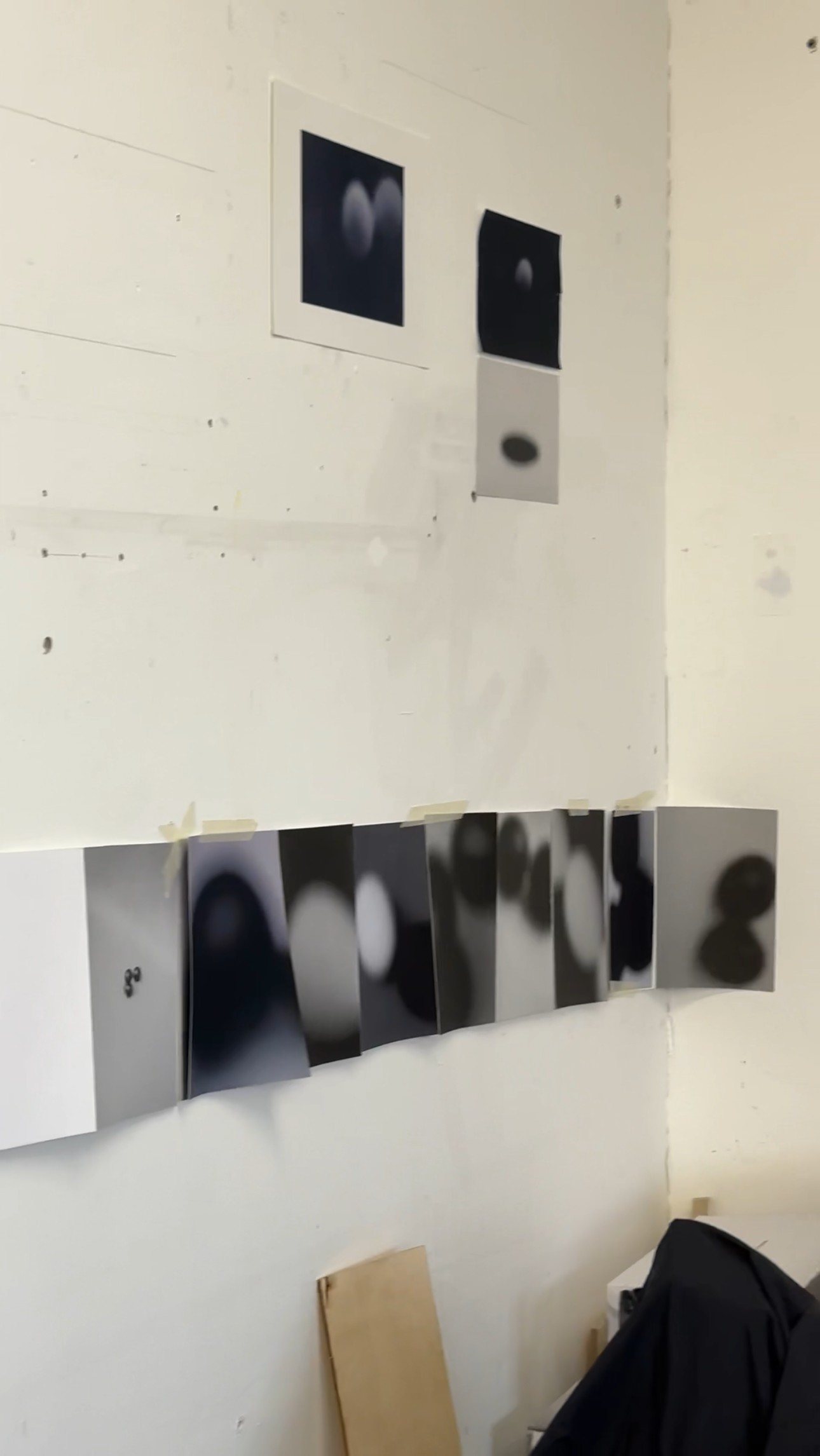
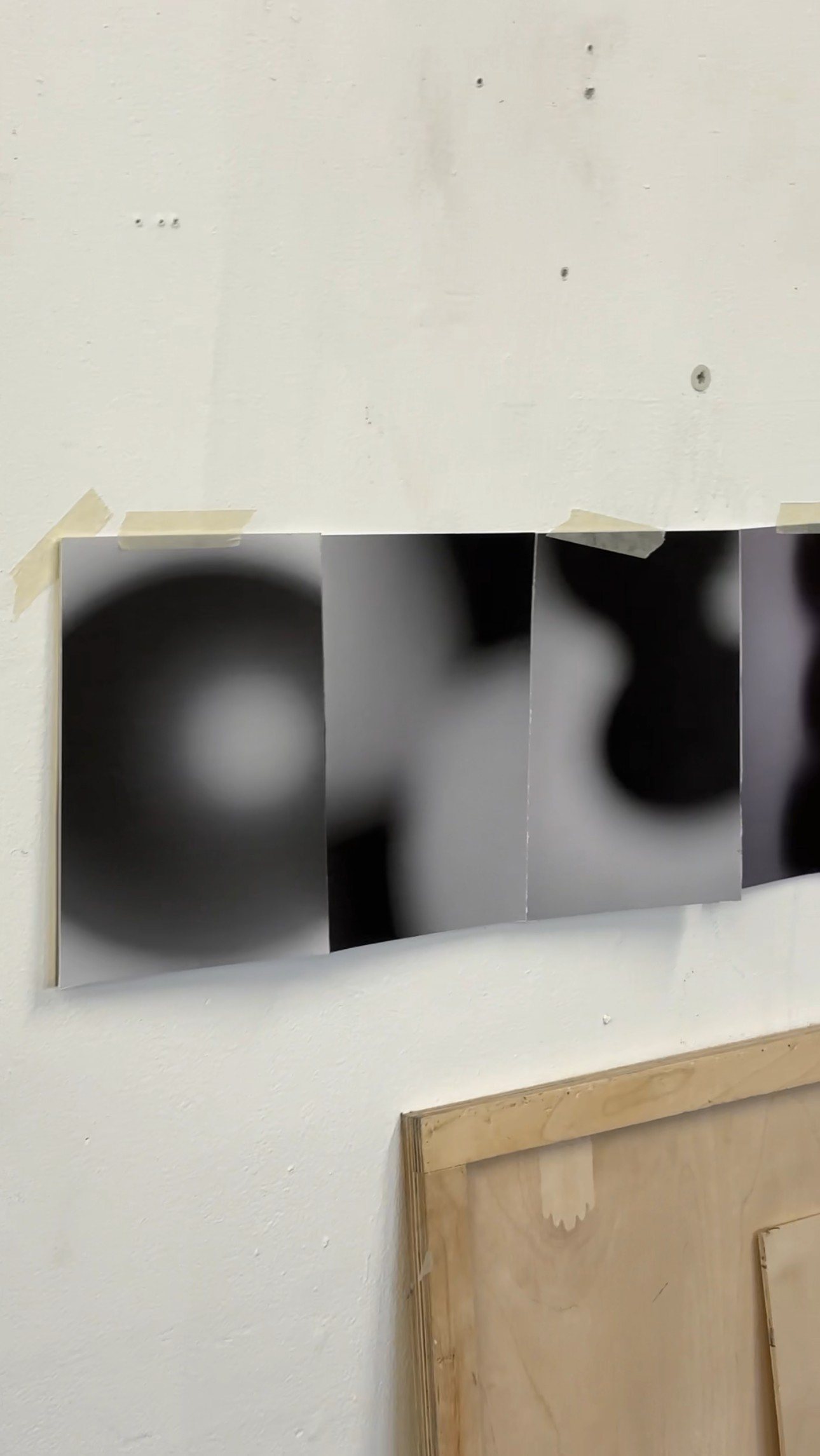
The strip carries no label, and its order is not explained. Each print follows the last for a reason that belongs to the artist; the viewer is given the sequence but not the rule. It is the same principle Goo has set out in public. In a work she has exhibited as Point, Line, and Plane, a two-metre run of blurred black-and-white prints, she borrows a title from Kandinsky, whose Point and Line to Plane, published at the Bauhaus in 1926, laid out a grammar of abstract form beginning with the dot. Where Kandinsky began with the abstract point, Goo begins with a recognisable object and reduces it, through the camera, towards abstraction. In her own description, points form lines and expand into planes, while the blur leaves it unclear whether the elements are connected at all.
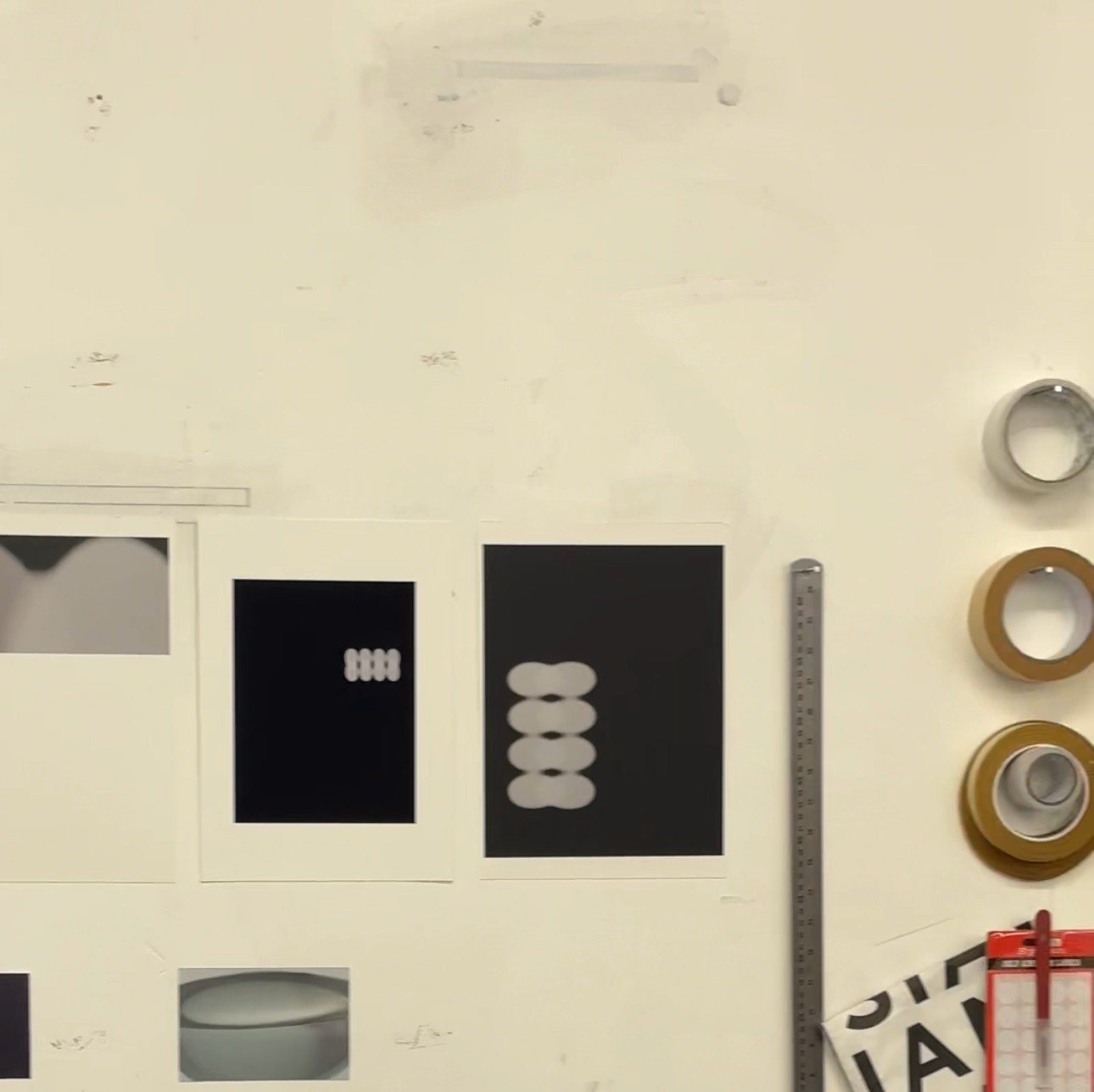
That uncertainty is the work. On the floor of the studio lies a black panel with white ovals set in overlapping pairs. Each pair can be read as two eggs touching, or as one egg recorded twice and slightly displaced, like a double exposure. Whether two forms touch or merely sit close is not settled by the object. It is settled by the person looking.
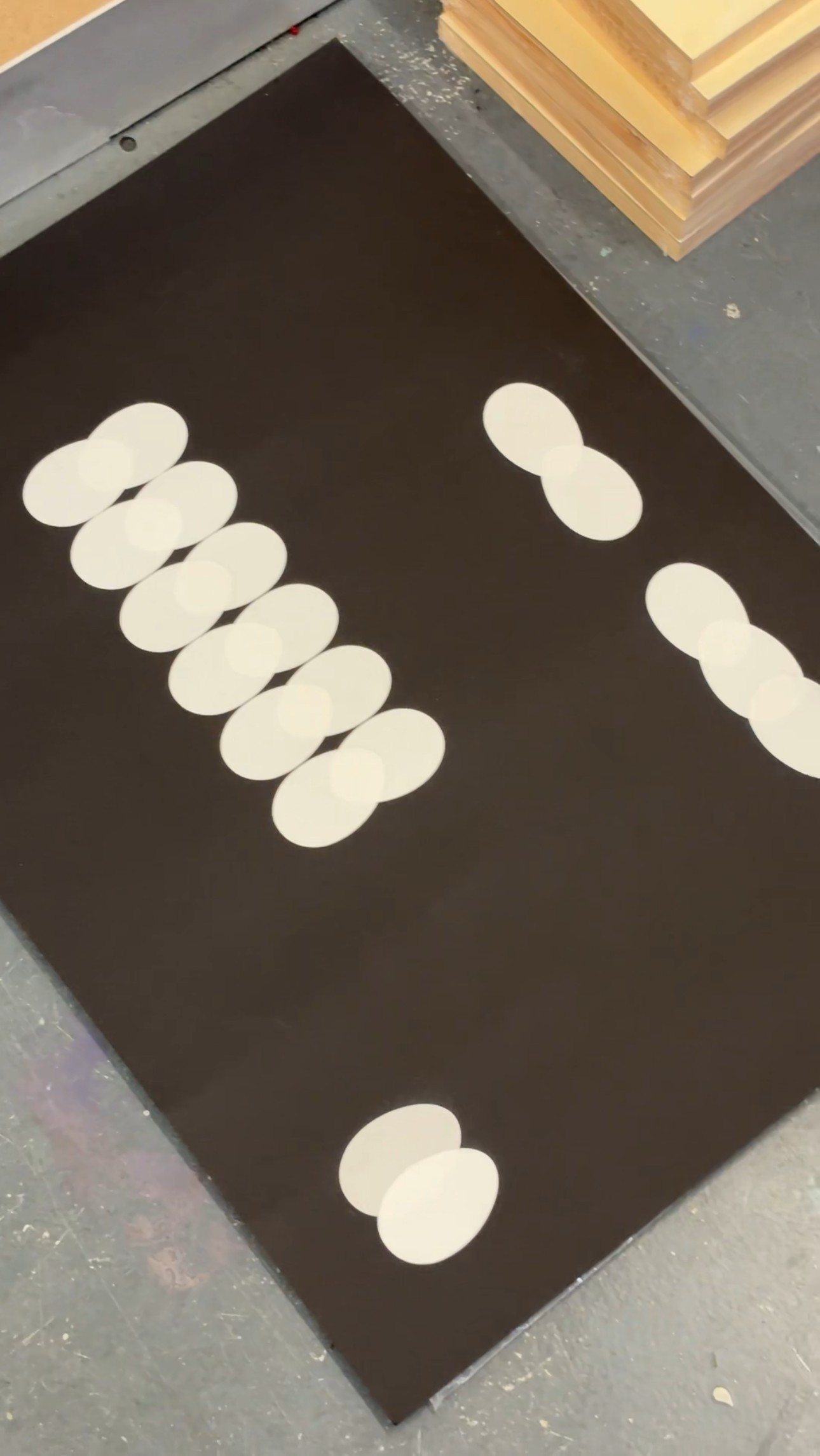
This is where the question that runs through Goo's work, "What do you think?", becomes more exact than it sounds. It is asked by an artist who keeps her own order and does not hand it over. It would be easy to take it as a gesture of openness, the familiar invitation to complete the work. In the studio it reads as a method. The works test how little an image needs to give before recognition happens, and what happens just before it does. The blur is not atmosphere. It is the threshold, held open. Seeing, here, is not receiving a picture but deciding about one, and the work slows that decision long enough for us to notice that we are making it.
Goo's statement grounds the practice in East Asian aesthetics and in the egg's symbolism of fragility, transformation and the cycles of life. The work seems most distinctive when those meanings are held in suspension rather than declared. The symbolic egg asks to be interpreted; the perceptual egg asks to be looked at, and it is through the looking that the symbols are earned. A tray of objects that share a shape but differ in surface, a strip of prints that will not resolve: these are not merely illustrations of fragility but experiments in how a form survives its changes of state, and in how much of a connection is made by the one who sees it.
Across the studio, Yoon's paintings make the other half of a pair. His images keep their edges and lose their coordinates; hers stay where they are and lose their edges. Both ask what remains of an image once it stops behaving like a record.
— KOUM Partners, London