
A work of art does not change when we learn something about the person who made it. What changes is harder to name.
J Seo's landscapes are usually met first as images: a mountain line held against a fading blue, a trace of orange dissolving into grey, translucent surfaces arranged one behind another. Nearly all of them are set in the same light: twilight, at either end of the day, the minute before it turns or the minute after, so that it is seldom clear whether the light is arriving or withdrawing. The paintings keep that minute. Photographs of her installations show suspended panels through which one image becomes visible inside the next. The compositions appear quiet, almost weightless.
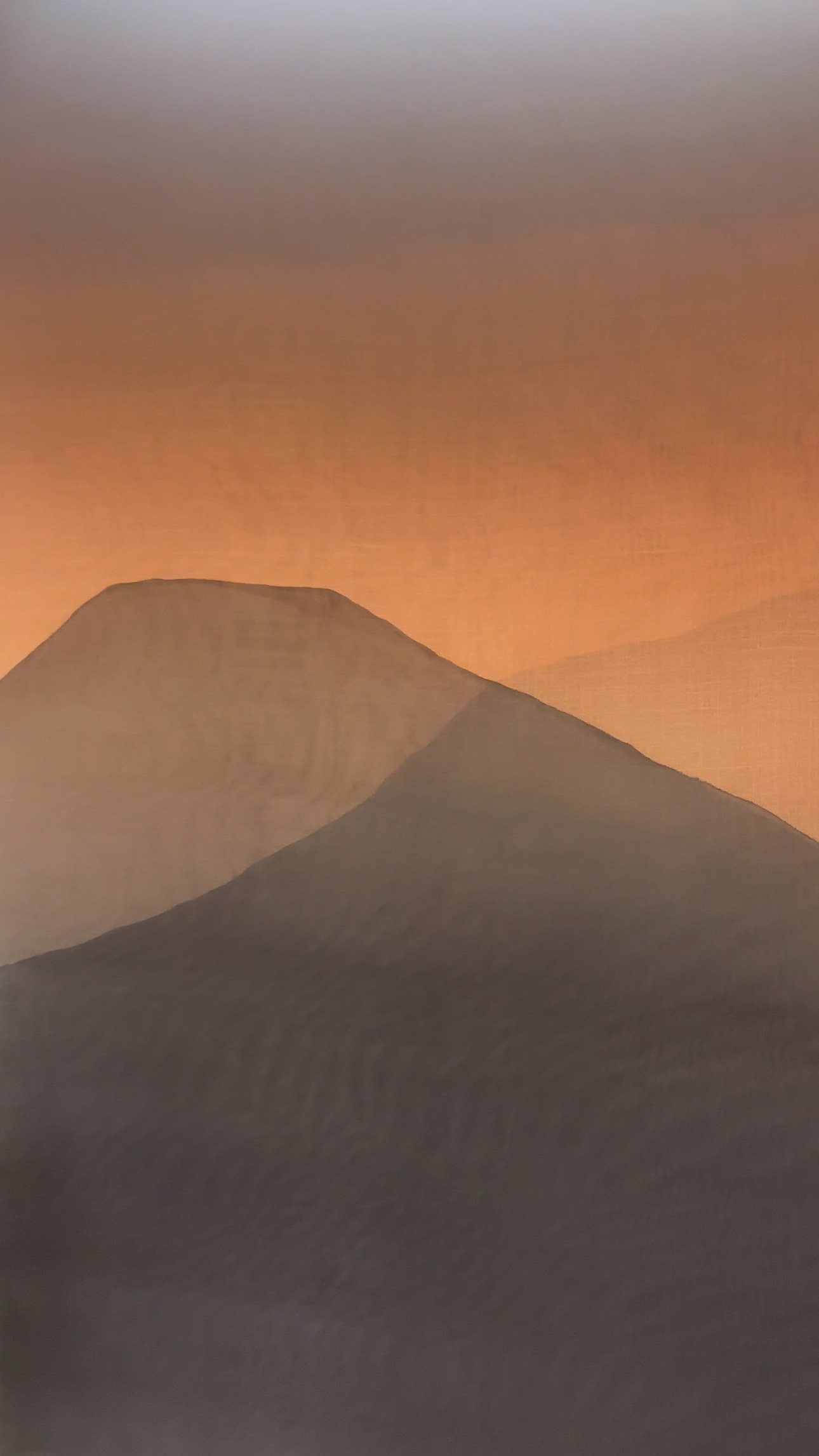
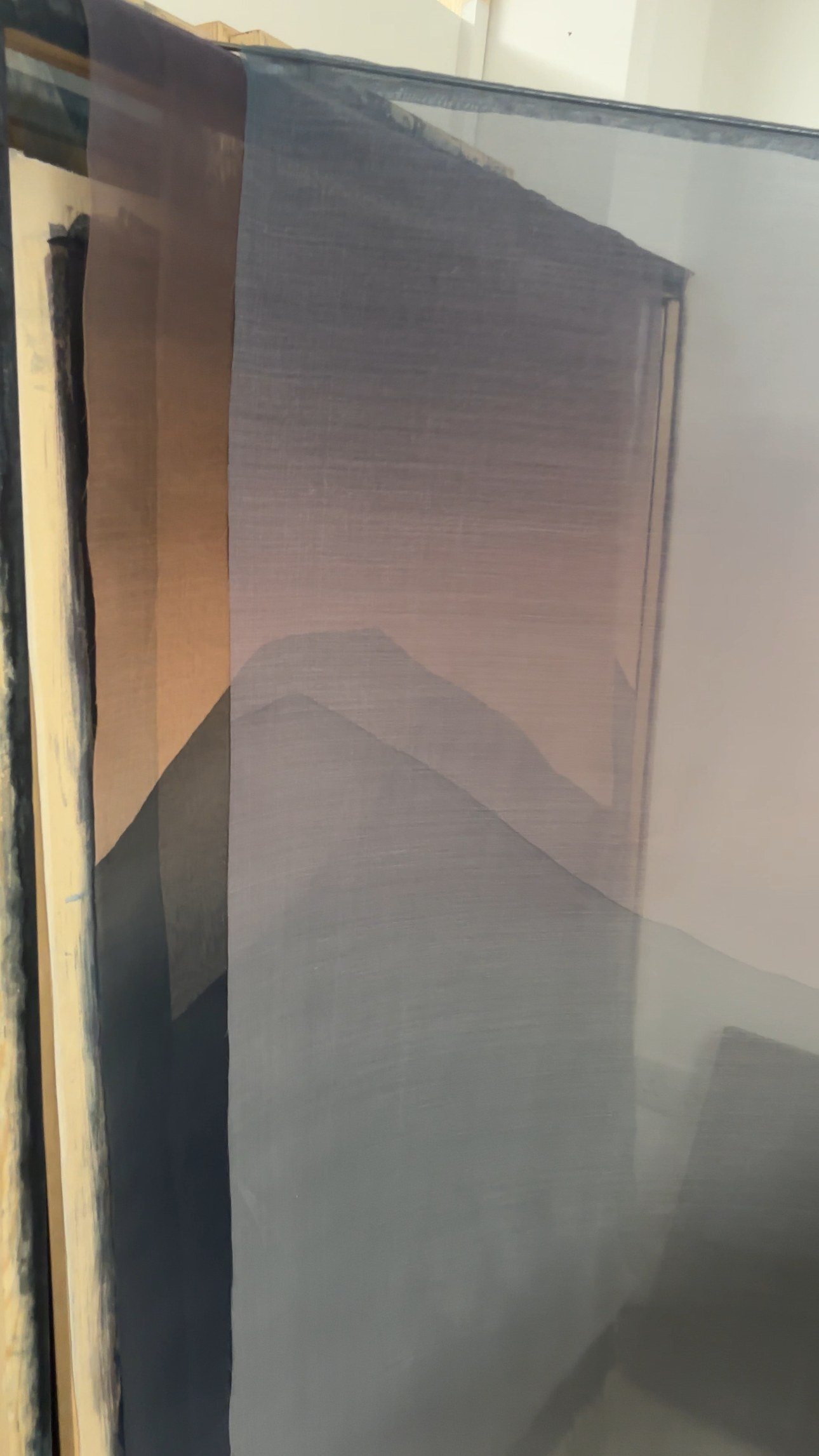
In the studio, their lightness proves more complicated.
Organza is translucent, but it is not without substance. It allows the space behind it to remain visible while altering the appearance of everything seen through it. It gathers into folds, occupies volume and recovers from being creased. Seo's painted mountain contours are often sharply defined, even as their positions in space remain uncertain. When two separately framed surfaces are brought together, another landscape appears between them. Shift their alignment and the image changes again. The landscape is not simply painted on a surface. Part of it is produced by the relationship between surfaces.
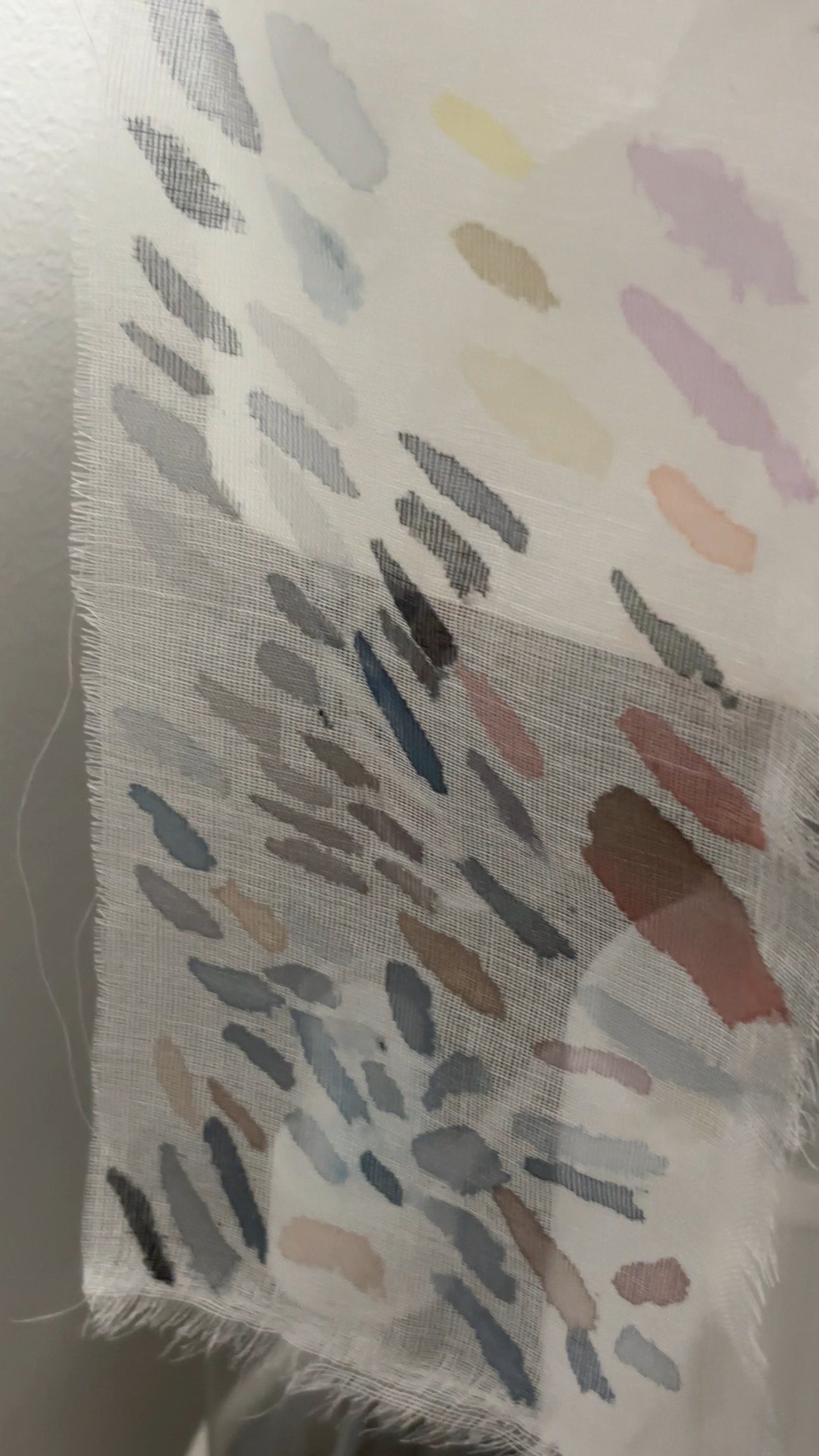
All of it is watercolour on silk that has been neither backed nor sized, and the image develops under the conditions silk imposes. A wash dries paler than it went on; colour is built gradually, in successive applications, and earlier marks remain perceptible beneath later ones. Nothing, she says, can be taken back. She has spoken of the violence she associates with covering a painted canvas, preferring a process in which previous decisions continue to register. Even a flaw is kept: a drop of water that fell on a clean panel became a way of working she now exhibits.
Her account of the work draws on impermanence. She remembers standing beside a lake at dawn and thinking, while still looking at the scene: "I'm going to miss this. This scene. This moment. And I'm still here." The present was already being recognised as a future memory while it was still happening. The light she recalls is the one that recurs in her landscapes. Her description of painting as "the attempt to hold what cannot be held" gives that experience a coherent vocabulary, and the landscapes, the slow accumulation of colour and the shifting relations between translucent panels can all be understood through it. She says herself that she is not a calm person, and that the work pursues what she lacks. Several of the paintings carry titles that say as much: Tumult; Do you ever regret who you are?; I pretended I hadn't cried, that I was okay.
Yet an artist's account of a practice is not an account of an entire person.
Among the materials in Seo's studio are notebooks filled with passages copied from books. She began the habit at about seven and has kept it for close to twenty years, accumulating more than ten volumes. None of the sentences is hers. Their authors differ, as do their subjects; attachment and its disappointments recur. What connects them is not a single doctrine, and their selection cannot be read as a declaration of what Seo believes. Their significance lies in their having been chosen at all.
She has observed that returning to the same book at another time brings an entirely different sentence into view. The printed words remain the same. The reader does not. Over time the notebooks become a record not of what was read but of what, at particular moments, could be noticed: a habit of noticing, and of keeping the noticing.
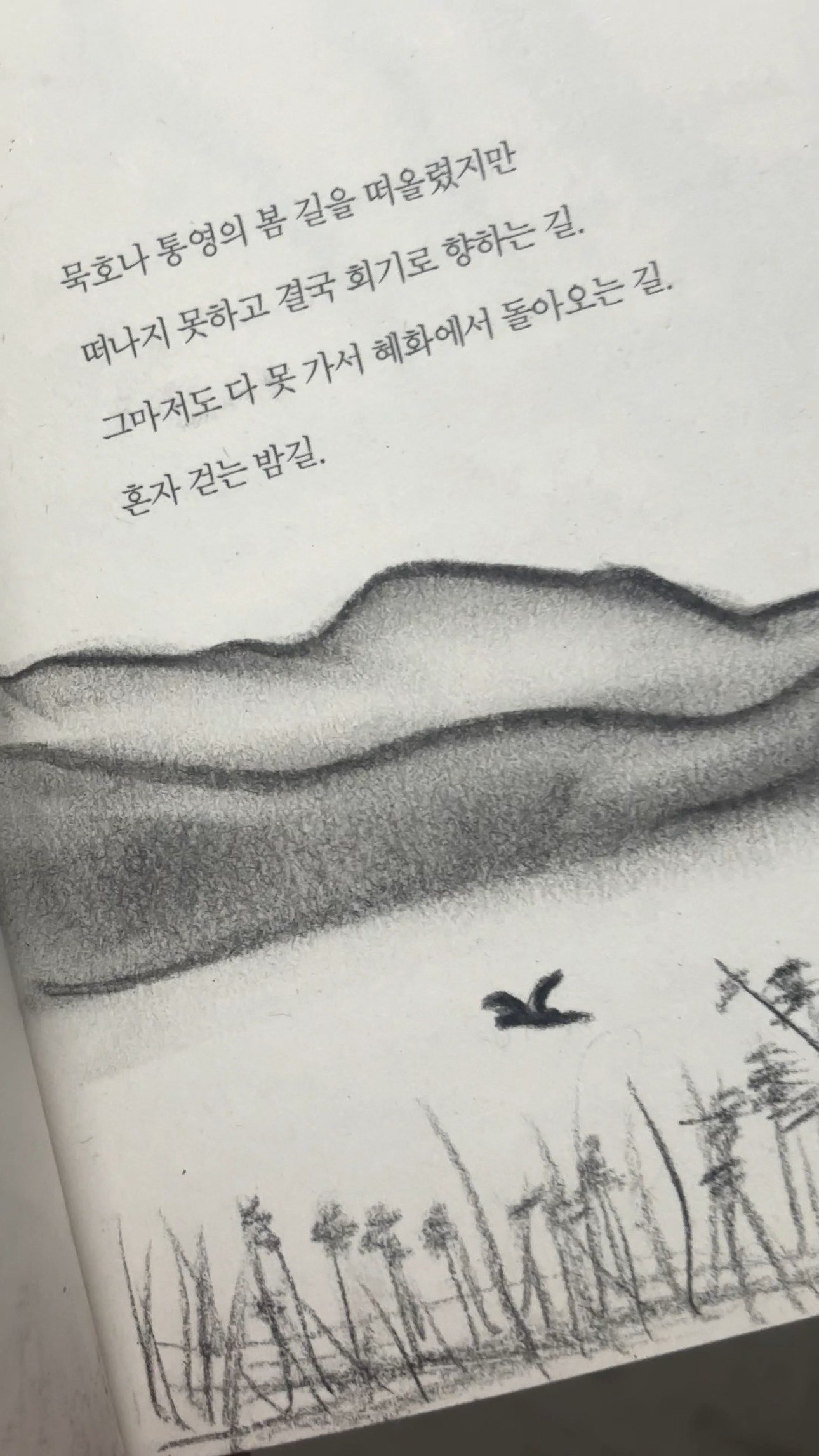
Elsewhere in the studio, printed books carry drawings across their pages: a second-hand copy of Shakespeare's The Tempest, and more recently a Korean book of essays bought for the purpose. Mountains, bare branches, a row of jars and a bird occupy pages already filled with other people's words. The text remains legible. These are neither illustrations nor erasures. They allow two kinds of attention to occupy the same page, which is also what the layered silk does.
It would be easy to make the notebooks explain the paintings: to identify a private sensibility behind the public work, or to claim that a lifelong habit of collecting sentences is the hidden origin of the landscapes. The paintings do not need that explanation. Their formal and material decisions stand whether or not the notebooks are known.
What the notebooks alter is the understanding of the person making them.
The Seo encountered through her work and its accompanying language is an artist concerned with impermanence, restraint and the impossibility of possession. The Seo encountered through the accumulated pages is also a reader drawn, for twenty years, to the intricacies of attachment, feeling and resolve. These are not contradictory identities, and neither is more authentic than the other. They are different ways in which one person becomes visible.
The distinction matters because looking is not a neutral act. An artist chooses what to make visible in a work, what to articulate in a statement and what to leave unspoken. A visitor arrives with choices already in place: preferences, expectations, the partial knowledge a photograph supplies. An encounter changes those conditions without bringing anyone closer to a final image.
Seo's organza is an exact visual instance of this. What lies behind the fabric is neither concealed nor presented untouched. The viewer sees through a material that takes part in what is seen, and when the surfaces move in relation to one another the resulting image belongs to neither of them alone.
The studio visit did not reveal a secret meaning in Seo's paintings, nor a definitive version of the artist behind them.
The work looked much as it had before. The person did not. That is the reason to go.
— KOUM Partners, London