
Editorial·KOUM Editorial · Artist
A Line That Will Not Settle
Park Kyoung Mug and a sixteenth-century rope bottle
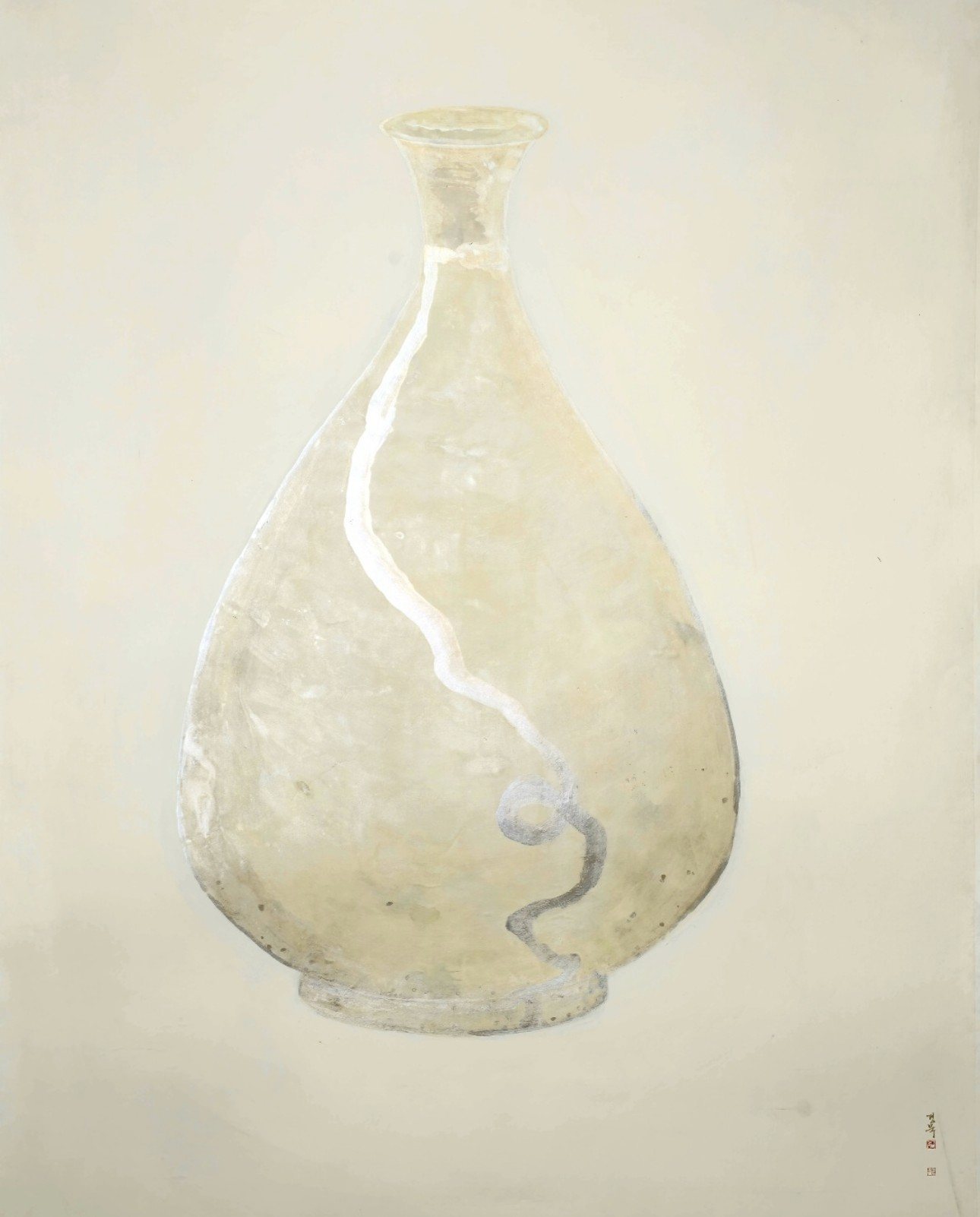
The bottle is 31.4 centimetres tall. Made in sixteenth-century Joseon, it fits comfortably in two hands. The sheet on which Park Kyoung Mug has painted it measures 136.5 by 98.5 centimetres, more than four times the object's height, closer to the scale of a standing body than to anything one would lift and pour.
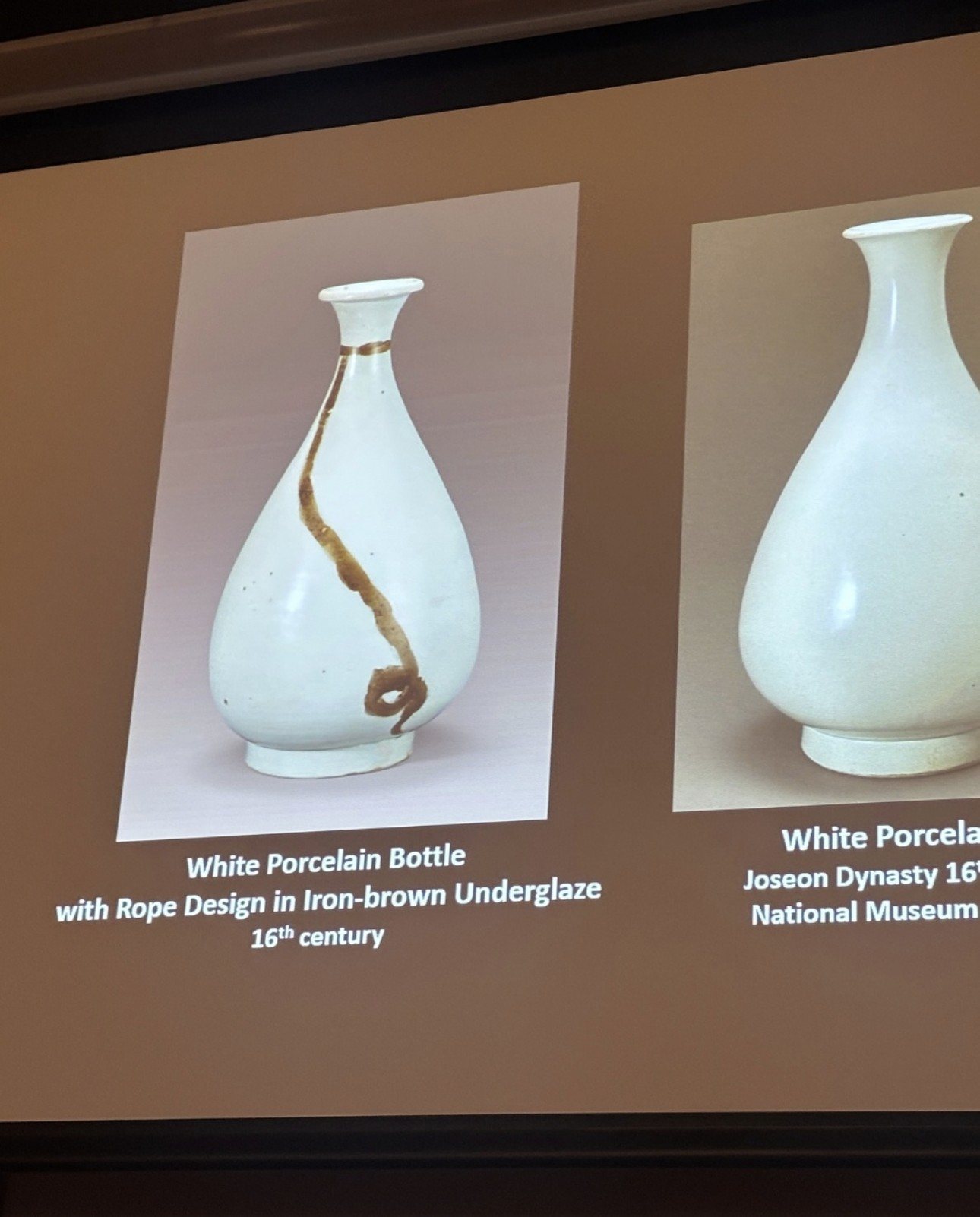
I first proposed the bottle to Park in July, as a possible point of departure for new work. In September I saw it again, projected on a lecture screen at Cambridge, a moment I have written about elsewhere. This essay concerns what happened in between: what a painter did with it.
The bottle, now in the National Museum of Korea and designated a Treasure in 1991, is almost bare. Around its narrow neck a single cord has been painted in iron-brown, as though tied there. From the neck it falls across the body, loosens, and coils at its end just above the foot. Nothing else decorates the surface.
Turn the bottle over, however, and inside the foot ring there is something most viewers never see: three syllables of sixteenth-century Hangul, also in iron-brown. I will not guess at their meaning here. It is enough that the bottle keeps a piece of writing where only someone holding it would find it.
When I asked Park about the motif, his answer did not settle it either. The cord, he wrote, is the motif of the rope-pattern bottle, but it can also look like the movement of a single snake. He compared this to hwajaeng, the Buddhist idea, associated with the Silla monk Wonhyo, of reconciling positions that appear to contradict one another within a wider understanding; he applied it to the bottle in the sense that the answer also lies within oneself. If one looks for the motif in form, he wrote, it moves from the rope-pattern bottle to a snake; if one does not remain with form, interpretation differs according to how each person sees.
Earlier in the summer, when we discussed the title, he had put it more briefly: interpretations may change, but the essence does not.
It is a useful position for a painter to take towards a historical object. It frees the image from illustration without cutting it loose from its source. The bottle remains the bottle, and the title still names the rope, but the line is permitted to do more than one thing.
Park has long been known for ink, built up in repeated layers. This painting uses none. It is made with slip, the liquid clay potters use, and acrylic on hanji.
Park is precise about why. He chose slip for its calm, earth-like colour and the ivory solidity he finds in it, which he attributes to its high proportion of natural material. On hanji, he says, it is matte, and it can be built up and taken back more readily than other pigments.
The deeper reason is a division of labour. He wanted to make work in which slip, rather than ink, carries the principal weight: work that ink cannot do, or need not do, and that only slip can do; and, conversely, work that only ink can do. In this painting the division is complete. A ceramic object is rendered, in part, in a material from the potter's workshop, and the painter's own material is set aside.
In the painting, the cord is what has changed most. On the sixteenth-century bottle it is the darkest mark on the surface, iron-brown against white. In Park's painting it runs pale, almost white, from the neck down across the body, and darkens to a soft grey only where it coils near the foot. In that one line, figure and ground have changed places.
I read this less as a departure from the source than as a reading of it. On the bottle, the line is what makes the plain surface visible as a surface; without it, the white body would have nothing to measure itself against. In the painting, the whole sheet has become pale, and the line has to find another way to be seen: by light rather than by darkness.
The rope bottle is one of three works Park has made this year in which a Joseon ceramic is rendered on hanji with slip. Alongside it are a jar decorated with grapes and a black-glazed jar after a Joseon vessel decorated with plum blossoms and bamboo. He describes the three as one series and the result of one study, differing only in the image each intention called for. The black jar returns to ink, used alongside slip and acrylic. As Park puts it, where there is black, there is ink; in the white works there is none.
A painting can show only one side of a bottle. Park's shows the front: the neck, the fall, the coil. The writing inside the foot stays where it has always been, out of sight, in a museum in Seoul. Not everything crosses from the object to the painting.
What Park has taken from it is not its likeness so much as its looseness: a line that will not settle into being only one thing.
Interpretations may change; the essence does not. For a bottle made to be held, and a painting made to be stood before, the sentence holds in both directions.
Park Kyoung Mug, White Jar Rope (working title), 2026. Slip and acrylic on hanji, 136.5 × 98.5 cm. After: White Porcelain Bottle with Rope Design in Iron-brown Underglaze, Joseon dynasty, 16th century. National Museum of Korea. Treasure.
Woori Ko · KOUM Partners · London